
By Karen Kalumuck
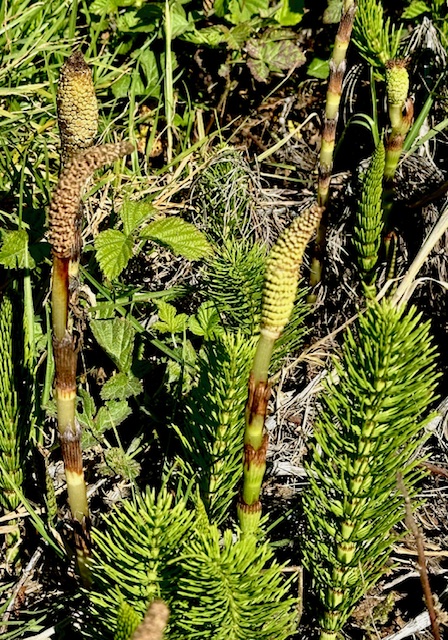
This beautiful plant is the Great Horsetail Fern, Equisitum telmateia. It is native to California, and can be found in wetlands and in or near wet soil. We see it at FMR almost year-round, on the banks of the the San Vicente creek. The horsetail fern is an ancient plant. Ferns evolved approximately 360 million years ago and its many species have populated the planet ever since. These ferns were witnesses to the dinosaurs, whose existence on earth began approximately 247 – 240 million years ago, and ended around 65.5 million years ago. You are looking at a species that is more than 100 million years older than the dinosaurs!
Ferns have a complex life cycle, and the photo illustrates two of the forms that it takes. They primarily exist as deep underground rhizomes, that can spread for hundreds of feet. During the early spring, the plant sends up what looks somewhat like asparagus – these are the fertile stems, or strobili. The tips of these strobili are packed with spores, which are dispersed much like pollen. The tiny, nearly microscopic spores germinate into the sexually reproducing plant, called a gametophyte. The gametophyte stage (not shown here) is tiny and grows in the moist soil. A single plant can produce both eggs and sperm. The fertilized egg (the zygote) grows into a sterile stem, and it also creates the initial rhizome of this nascent fern.
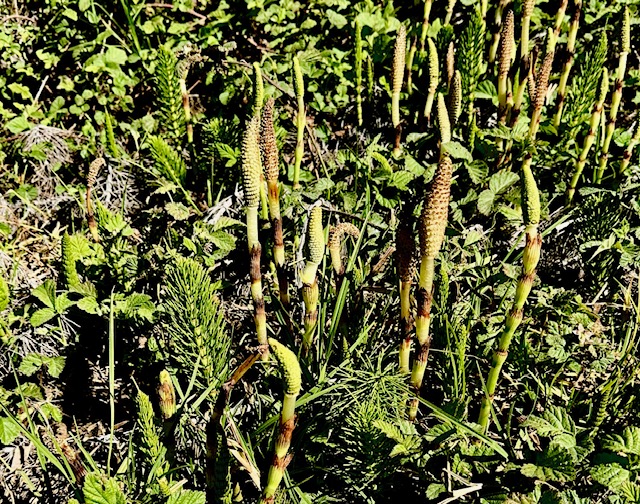
After spore dispersion, the fertile stems die, and the rhizomes send up sterile, photosynthetic stems. These are the familiar green, bottle-brush like plants that we see most often. These stems are photosynthetic, and create carbohydrates that are stored in tubers in the underground rhizomes. This cache of food allows the rhizomes to survive winter and other challenging environmental experiences. In spring, the cycle begins again.
The fertile stems of Equisetum contain a high concentration of silica. This abrasive material has led the plant to be used for polishing of wood, rocks, and metal. The hollow stems are divided by nodes and internodes, based primarily on the deposition of silica. The segments are easily snapped apart, and put back together. Some lore suggests that this characteristic made them attractive to use as toys. Other sources suggest that horsetail ferns were the inspiration for the creation of Tinkertoys. While plausible, inventor Charles H. Pajeau came up with the idea, back in 1913, by watching children create structures using empty thread spools, pencils, and sticks.